

BOBST collaborates in circular economy drive for packaging
BOBST is working closely with packagingoriented partners across the range of raw materials, conversion, usage and final disposal/ recycling, to develop new materials and techniques to minimize environmental impact.
A growing list of both major and small brands are committed to replacing single-use packaging with alternatives that are reusable, recyclable or compostable materials, with the goal of achieving “circular economy” for packaging as early as 2025. Recyclability of flexible packaging is particularly aided by a switch to mono-materials and de-layering, with some products already reaching retail shelves.
However, the infrastructures and procedures to collect, sort and reprocess this packaging after use are lagging behind in some global territories, especially for post-consumer waste.
As a machinery manufacturer BOBST is now collaborating with its “customers’ suppliers” and its “customers’ customers” up and down the entire value chain, something rarely experienced before in the packaging sector.
Technical issues such as barrier layers, strength, durability and printability are being solved. BOBST is particularly active in working with technical partners including machine manufacturers (Brückner Maschinenbau, Elba and Hosokawa Alpine), raw material producers (Dow Chemical, Michelman, Mitsui Chemicals, Sun Chemical and Siegwerk), film producers (Danaflex, Indopoly Swakarsa Industry, Taghleef Industries and Uflex) and converters (Constantia Flexibles) on such material developments. The site of BOBST in Manchester, United Kingdom, has been established as a center of excellence for high barrier films and it has worked with Manchester Metropolitan University on metallization projects.
Since 2019 BOBST has been a member of the Circular Economy for Flexible Packaging (CEFLEX) initiative, a collaboration of over 160 European companies, associations and organizations representing the entire value chain of flexible packaging. A circular economy for packaging means establishing whole-lifecycle methods and processes for reducing waste as much as possible, ideally to zero but if not to minimize the environmental impact of any remaining waste, for instance by using compostable materials. One definition of its goals is called the 3Rs: reduce, reuse, recycle.
CEFLEX aims to make all uses of flexible packaging in Europe “circular” by 2025. This includes collection of all flexible packaging, with over 80% of the recycled materials channeled into valuable new markets and applications to substitute them for virgin materials. It means establishing or extending the collection, sorting and reprocessing infrastructure and economy for post-consumer flexible packaging across Europe.
Within CEFLEX BOBST is a member of two of the seven Workstreams: Workstream 1 (Design Guidelines for mono-materials PP and PE) and Workstream 2 (Understanding the market). It is also an observer on Workstream 6 (Facilitating technologies). BOBST is also very active in the taskforce “Application rPP – Pouch” in Workstream 3 (Sustainable end markets), where it is working to develop printable monomaterial metallized and laminated pouches from BOPP film with recycled content (rBOPP). This aims to prove that recycled polypropylene (rPP) can be used for certain non-food packaging applications. Test quantities of the film have been produced by Taghleef Industries using rPP pellets. These were sourced from trials performed by CEFLEX using the Quality Recycling Process to obtain rPP from flexible packaging post-consumer recycled polymer. The film has been metallized by BOBST in Manchester and sent to the site of BOBST in San Giorgio de Monferrato, Italy, for lamination. Next it will be printed at the site of BOBST in Bielefeld, Germany, and finally made into pouches by its partner company Elba.
In August 2020, Dr Carolin Struller, Senior Research Scientist and Sustainability Ambassador at Bobst Manchester, was confirmed in her application for a Future Leaders Fellowship by the governmentsponsored UK Research and Innovation body. The Fellowship is intended to allow universities and businesses to develop their most talented early career researchers and innovators. Dr Struller’s Fellowship will last for four years and will fund and support her work within BOBST on a portfolio of interlinked projects under the umbrella theme of sustainability, including working on mono-material solutions, paper/fiber-based solutions, biodegradable and compostable solutions. The intention is that these will be products that go to market.
“The Fellowship will cover work starting in 2021 and the four years will coincide exactly with the 2025 target of global brands, retailers and packaging producers to achieve 100% reusable, recyclable and compostable packaging”, said Dr Struller.
Part of the project is also working on the development of a new high-speed clear barrier process. Prior to that the site of Manchester and Dr Struller had already been working with Manchester Metropolitan University plus Bobst Italia in San Giorgio de Monferrato and other industry partners, to develop a new production process for vacuum metallized films intended for flexible packaging applications.
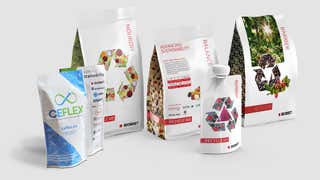
Further work by BOBST and a range of partners saw the demonstration of new high-barrier pouches made from recyclable mono-materials at the K Show 2019 in Düsseldorf, Germany. BOBST called these “Hero Samples GEN 1”, including recyclable PP and PE based standard “non-engineered” films but also “engineered films” with special co-extruded skin layers. At K in 2019 it demonstrated three different shapes of pouches.
Since then BOBST has extended these concepts to what it calls “Hero Samples GEN 2”, still with a big focus on recyclable mono-material solutions, but also taking in compostable/biodegradable and paper/fiber based flexible barrier solutions, as well as the processing of films (rPP and rPE) produced with recycled content (post-consumer resins). These are particularly relevant to the CEFLEX projects. The 2025 target for achieving a circular economy of flexible packaging in Europe is certainly ambitious, but most parties are confident that it is achievable. BOBST is playing a full role in working with its partners to help them reach this goal.
Bobst Mex SA, Switzerland
Latest news
Oct 07, 2026
BOBST Connect: Progress, Performance, and Potential

Jul 19, 2026
Colorman Ireland and BOBST: Advancing smart, connected packaging production together
Jul 13, 2026
BOBST Becomes First Packaging Machinery Manufacturer to Achieve Carbon Literacy Platinum Award